


Pouey International’s Expertise
In an increasingly interconnected economic environment, businesses rely on an extensive network of suppliers, commercial partners, service providers and subcontractors. While these relationships are essential to performance and growth, they also represent a major source of external risk.
Third-party risk management (i.e. the management of risks related to external entities with which a company maintains business relationships) consists in identifying, analysing and controlling all risks associated with these external stakeholders. This approach is preventive and structured, going far beyond occasional or ad hoc checks.
By accessing reliable financial data, verifying legal compliance and identifying adverse events, companies are able to make informed decisions, protect their strategic assets and safeguard their reputation.
What is Third-Party Risk?
Risk is the occurrence of an unpredictable, or at least uncertain, event likely to affect the individuals, assets and activities of a company, and to alter its financial position and results.
(Source: Management Dictionary – Élie Cohen)
Third-party risk refers to any threat that may impact a company’s financial soundness, operational continuity, data security or reputation as a result of its relationships with external partners. It encompasses a set of interdependent risks, the management of which relies on a rigorous and continuous assessment throughout the entire lifecycle of the partner.
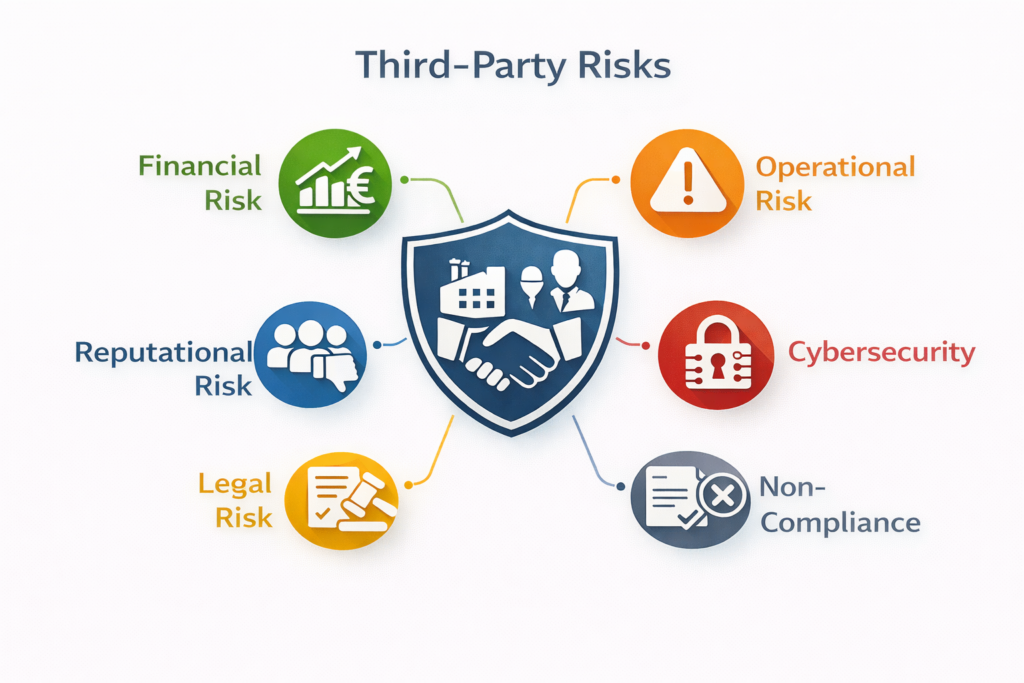
Main Categories of External Risks
Financial and Credit Risk
The financial fragility of a supplier or customer may lead to supply chain disruptions, payment defaults or an inability to meet contractual obligations. The analysis of financial statements, credit ratings and balance sheet structures forms a fundamental basis for risk prevention.
Operational Risk
Operational risk relates to a partner’s ability to deliver expected goods or services in accordance with agreed timelines, quality standards and contractual requirements. It may result from insufficient resources, poor organisation or logistical constraints.
Cyber and Data Security Risks
Third-party access to information systems exposes companies to risks of data breaches, cyberattacks or intellectual property compromise. A failure at supplier level can have a direct impact on the entire digital ecosystem.
Legal and Regulatory Compliance Risk
Non-compliance with legal obligations (GDPR, labour law, local or sector-specific regulations) can result in financial penalties and litigation. Verifying company registration, as well as the absence of legal proceedings or sanctions, is a prerequisite.
Reputational Risk
A partner’s social, ethical or environmental practices may have a lasting impact on the contracting company’s brand image, even in the absence of a direct legal link.
Key Stages of Effective Third-Party Risk Management
1. Definition of Criteria and Partner Qualification
The first step is to define a level of risk tolerance based on the criticality of the partner. Not all third parties present the same level of exposure or risk.
Before entering into any contractual relationship, a thorough due diligence process is carried out:
- financial analysis and information searches in the event of non-disclosure,
- verification of credit ratings,
- consultation of company registers,
- identification of potential adverse events.
This phase makes it possible to establish an objective initial risk profile.
2. Continuous Partner Monitoring
Risk evolves over time. A financially stable company today may face difficulties tomorrow. Modern third-party risk management systems rely on automated and continuous monitoring to detect:
- financial deterioration,
- legal or structural changes,
- the emergence of disputes or adverse events.
This approach enables rapid and proportionate responses and is essential given the rapid obsolescence of financial data, which reflects an objective but historical situation.
3. Implementation of Mitigation Measures
When weak or strong warning signals are identified, corrective actions are implemented:
- adjustment of contractual clauses and payment terms,
- reinforcement of financial transparency requirements,
- targeted audits,
- business continuity or remediation plans.
The objective is to reduce exposure without unnecessarily disrupting the commercial relationship.
4. Securing the End of the Relationship
The termination of a partnership is a critical phase. It is essential to ensure:
- removal of system access rights,
- return or destruction of confidential data,
- legal compliance of the termination process.
Proper exit management limits residual risks and protects the company’s assets.
Why Third-Party Risk Management Has Become Essential
Managing risks related to customers, suppliers and partners is now a strategic investment serving business resilience and credibility.
It enables companies to:
- reduce financial and legal losses,
- ensure business continuity,
- improve the quality of commercial decision-making,
- build a competitive advantage based on reliable data.
The most successful companies no longer select partners solely on price, but on financial strength, compliance and long-term reliability.
Pouey International’s Contribution to Third-Party Risk Management
Through its financial and commercial information solutions, Pouey International supports businesses in securing their B2B relationships.
Its services, including SCOREMAP, in-depth commercial and financial investigations, as well as credit insurance, enable companies to:
- assess partner reliability,
- anticipate and secure risks of non-payment,
- strengthen decision-making processes,
- build sustainable and controlled commercial relationships.
01.08.2026
